It’s May! It’s Lyme awareness month and In the last week, I have signed a petition to try to get a specialist Lyme Clinic in the UK where Lyme disease patients can get the specialist treatment they need to fully recover from Lyme disease or other tick born illnesses. This petition needs 10,000 signatures to get a response from parliament. 100,000 to be considered for debate. Why is this important to me? This is because I still have the question of Chronic Lyme disease hanging over my chronic pain.
In 2009 we went on a holiday to the Dolomite mountains. Prior to going on holiday, we had been wild camping on Dartmoor and I had removed three ticks when we returned home and thought nothing more about it. When we went to Italy I had also got bitten by a few mosquitos. My Bites started to inflame and I became bedridden for 24 hours with a fever and sickness. When I stopped being sick I was left with overwhelming fatigue and pain in both my legs due to swelling. This is a picture of my legs a few days after being bitten. 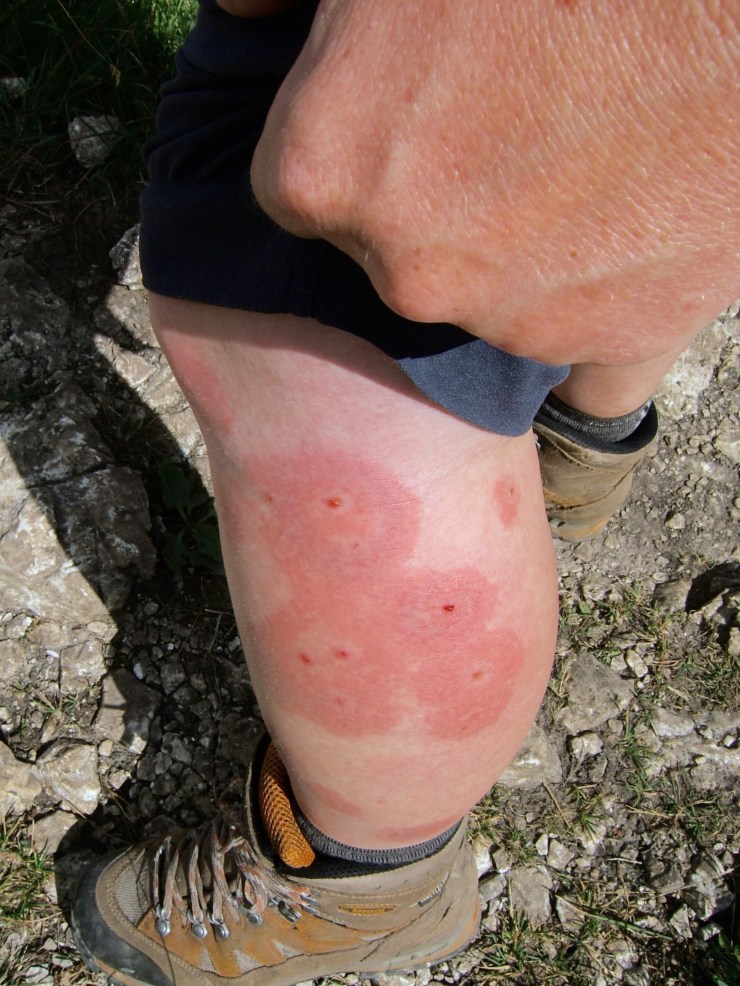
These bites felt unlike any I has received before. They weren’t itchy like normal mosquito bites, they swelled really badly making them painful. Due to the unique presentation of these bites, we went to a pharmacy to ask for some bite cream that was better than antisan. The pharmacist told me that I should go immediately to the doctor. This we did and I was given some antibiotic cream to put on it and I was instructed to visit my own doctor on our return to England. When we returned home all I had left was large purple marks, I felt that the cream had cleared the bites and I chose not to bother the doctor. At this point, I never knew about Lyme disease and the accompanying bull’s eye rash.
From that year on I have fought against fatigue and I started to get pain in my joints, muscles and tendons. I thought it was just niggles from my ageing body, but the pains got progressively worse. In 2014 due to increased pain, tiredness in my joints, severe pain in my spine, neck and tendons, severe headaches, problems with my balance and a long list of other ailments. I took a visit to my GP. My doctor’s immediate concern was Lyme disease so put me forward for an ELISA test and also an MRI scan and several blood tests to rule a number of illnesses out. I was referred to an infectious disease specialist who could look into what was going on. My specialist requested an immunoblot test for Lyme and prescribed me the treatment for Lyme as a precaution because of all the symptoms where indicative of Lyme.
Both my Lyme tests and all my blood tests returned with negative results. My MRI scan returned with multiple lesions. The lesions presented like MS so I was sent for a lumbar puncture. I thought I was starting to point in the right direction for a firm diagnosis but this lumbar puncture came back negative to MS. At this point, I was told that Lyme and MS, fibromyalgia could be confused for one another. There’s a lot of overlap in symptoms! In fact, Lyme is nicknamed the “great imitator” because it’s frequently misdiagnosed as fibromyalgia, chronic fatigue syndrome, multiple sclerosis and other conditions. At this point, I had completed my treatment for Lyme and had seen some improvements in my symptoms.
A few months after my treatment stopped I went back to my specialist. She repeated the Elisha and immunoblot tests because everything was continuing to point towards Lyme. She contacted the Lyme specialists in the testing lab to discuss my test results and the presentation of my brain lesions (Lyme bacteria can imitate MS lesions in the brain). She asked for advice on treatment and she was then instructed to give me a second course of Lyme treatment.
Lyme tests available on the NHS are unreliable. The ELISA test is generally given first to detect if the body has produced antibodies against the Lyme bacteria. The problem is that ELISA only detects about half of the Lyme cases.
“While a positive ELISA test is a reasonably reliable indication of infection, a negative test is meaningless,”
The second test, the western blot, is a little more accurate than the ELISA, but there’s controversy over what constitutes a positive test. Some consider a western blot to be positive if the patient tests positive for five or more Lyme bands. In contrast, others diagnose Lyme based on a patient’s clinical symptoms and the presence of one Lyme-specific band. Lyme-specific bands only test positive if the patient has been exposed to Lyme. Often the sickest patients will have a negative test because their immune systems are too weak to develop the antibodies screened for by the tests.
Whilst continuing with my second Lyme treatment the specialist continued to seek a diagnosis and some understanding to my pain and I was sent to a rheumatologist to rule out rheumatoid arthritis and it was at this point I was diagnosed with fibromyalgia. All testing stopped I had received my diagnosis.
I was exceptionally lucky to have been in receipt of Lyme treatment as a precaution. My specialist had treated me by my symptoms, without the conclusive tests most doctors require. The GPs and specialists have treated me by the guidelines which suggest that once you have been treated with the course of antibiotics then you are free of the Lyme bacteria. Research shows that a lot of patients have lingering symptoms which need further care to support their recovery. Despite this growing area of evidence, there is still a lot of controversy over whether Chronic Lyme or post Lyme is real. This term describes the persistent symptoms that continue after Lyme infection, such as tiredness, aches and pains. When someone continues to get pain it is considered to be something other than Lyme, maybe fibromyalgia or chronic fatigue etc. Ignoring these lingering symptoms means a lot of Lyme sufferers continue to suffer and struggle to treat misdiagnosed problems for many years without being given targeted support and the holistic care they need to recover completely. Some continue to get sicker with increasing damage to their hearts, organs, and brain all the time being moved from one specialist to another. Research has still got a lot further to go to gain certainty into what is actually going on when symptoms are persistent. One of the difficulties is that the bacteria behave differently with each patient meaning the support and treatment is very individual and changes from patient to patient. Having a centre of excellence focused on Lyme disease and other tic Bourne illnesses would help Lyme literate doctors to give the individualised support the patients need to make full recoveries.
Please could you sign and share the petition to play your part to help, one vote at a time, get closer to its 100,000 target.
 Walking to health; the challenge
Wow you have been on quite a journey so far! Thank you for sharing Annmarie! I have signed-Hx
LikeLike
It hasn’t been without challenges, but it’s what makes life interesting I guess. Thank you so much for signing Helen xx
LikeLiked by 1 person